What Happens When the Way You Work Costs More Than You Realise
When Investor's Magazine reached out, I didn't pitch them a productivity trend or a listicle about time-blocking. I shared what I actually see inside businesses and what it costs them.
Because here's the thing no one talks about in leadership conversations: the biggest drag on performance in most Mauritian SMEs isn't talent. It isn't budget. It's the invisible weight of how work is organised.
The attention economy is real — and it's hitting your team
Modern work runs on cognitive load. Every message, every task switch, every half-clarified expectation chips away at your team's ability to do the thing you actually hired them for.
Research consistently shows that knowledge workers spend a significant portion of their time on coordination and communication — not on high-value output. That's not a motivation problem. It's a work design problem.
When I work with SMEs and teams in Mauritius, I see the same patterns repeatedly: skilled people operating well below their true capacity. Not because they aren't trying. Because the structure around them isn't built to support focused, effective work.
Growth introduces complexity. Complexity needs design.
Scaling a team doesn't just mean adding people. It means more decisions, more communication loops, more opportunities for things to fall through the gaps.
Without deliberate work design, growth creates noise. Leaders spend more time managing the flow of work than doing it. Teams wait for clarity that never quite arrives. Good ideas move slowly.
The businesses I support through Virtufully — team leads, HR managers, SME owners — are often at exactly this tipping point. Things are working, but not as well as they should. Everyone is busy, but the results don't quite reflect the effort.
That gap? It's solvable. But not with harder work. With better systems.
What this looks like in practice
Work design at team level means asking sharper questions:
Where are decisions getting stuck?
Which processes repeat themselves and could be clarified, templated, or automated?
What's creating interruptions for your highest-output people?
Are roles and responsibilities clear enough that people can move without waiting?
AI has a real role here too — not as a shortcut, but as a structural tool. When AI is integrated thoughtfully into workflows, it removes operational load and frees teams to do the work that actually requires human judgment.
That's the shift I'm focused on helping teams make.
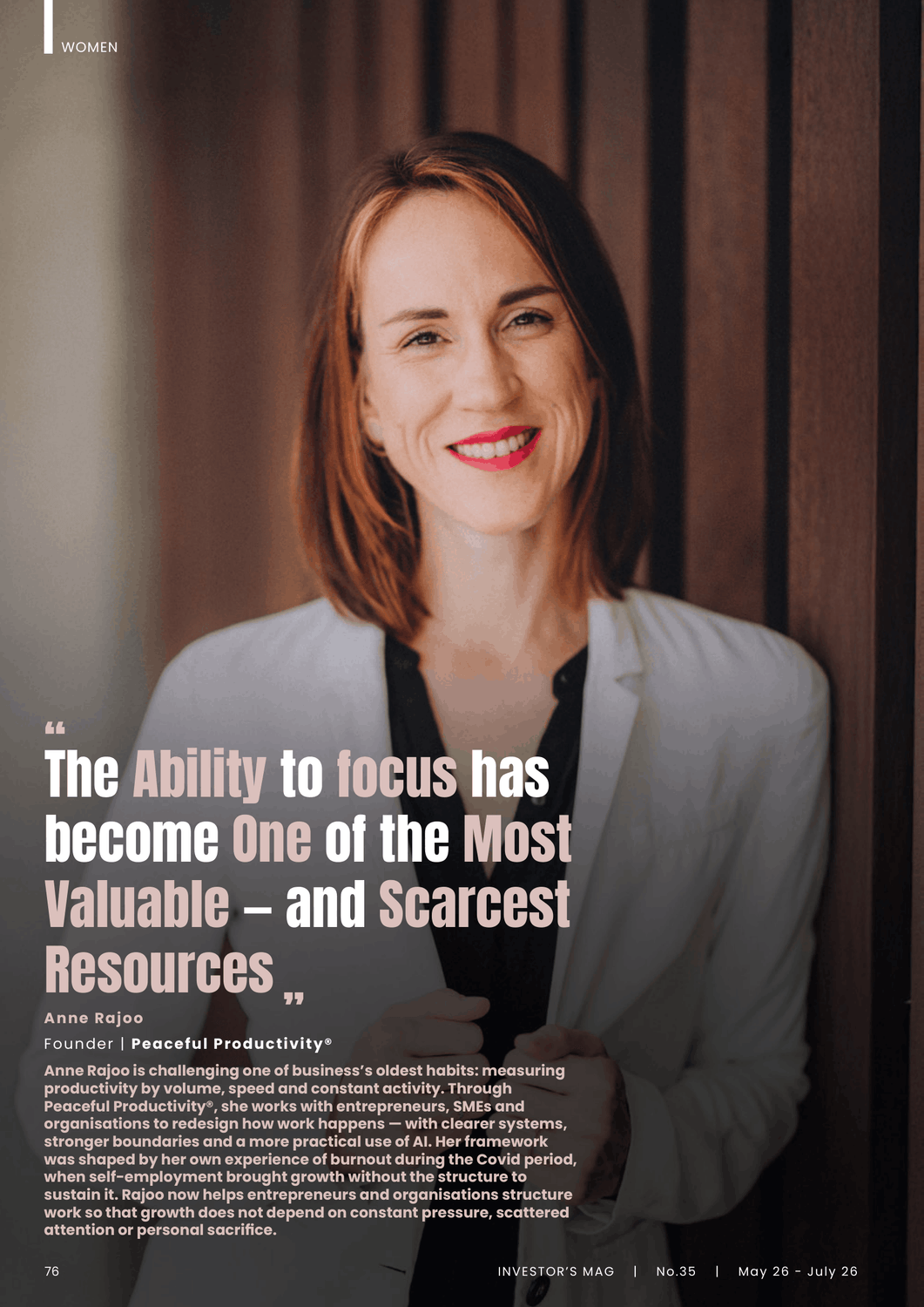
Read the full feature
The full interview is in Investor's Magazine Issue 35 (May–July 2026), available now. It covers the Peaceful Productivity® framework, burnout as a structural problem, AI adoption in Mauritian businesses, and what sustainable performance actually looks like for growing organisations.
If this topic resonates.
I write about work design, team performance and AI for SMEs and impact-driven organisations in the Designing Better Work newsletter on LinkedIn — published regularly for leaders who want practical thinking, not productivity hacks.

Start With Clarity!
If your team feels busy but progress feels harder than it should, begin by understanding what’s really causing the friction.
What is unclear work costing you?
Use the calculator to estimate lost time, hidden friction, and productivity drag.
Free Guide: 3 Drivers of Productivity Loss
Understand the hidden causes of slow progress and reactive work.
Quick links
Follow us
What is unclear work actually costing you?