Virtufully · Thought Paper
THE ATTENTION RECESSION
Why Working Harder Stopped Working.
Author: Anne Rajoo · July 2026
Why should you read this
Your team isn't underperforming because they're not working hard enough. They're operating inside a system that quietly accumulates debt, in coordination, decisions, and recovery, until it collapses into burnout or attrition.
Most productivity advice ignores this because it assumes people are rational, well-rested, and self-correcting. This paper names the system, shows why "push harder" makes it worse, and gives leaders a structural playbook to fix it before it crashes.
Table of Contents
Executive Brief
Something is not working about the way we work. Teams are busier than ever, supported by more tools than ever, and still falling behind on the work that requires thinking, judgment, and good decisions. Most organisations respond by optimising harder. It rarely works, because the diagnosis is wrong.
This paper makes one argument: team underperformance is a design problem, not a discipline problem. The productivity model most organisations inherited was built for industrial work — visible effort, stable output, interchangeable capacity. Modern work runs on attention, and attention was never designed for.
The cost is not marginal. Gallup puts the price of disengagement at $9.3 trillion a year — roughly 9% of global GDP. Inside organisations it shows up smaller and quieter: around a third of the working week consumed by communication about work rather than the work itself.
The paper introduces two ideas leaders can use.
The Four Pressure Points — Clarity, Capacity, Coordination, Control — the four places where work design breaks, in the same sequence, with the same consequences, across organisations of every size.
Work Debt — what an organisation owes the future when today's demands exceed today's sustainable capacity. It comes in three forms (coordination debt, decision debt, recovery debt), and like financial debt, it compounds. Most organisations are servicing debt they have never measured.
The response this paper argues for is not resilience training, another tool, or asking people to prioritise harder. Those interventions move pressure around; they do not reduce it. The response is structural: redesign the conditions under which work happens — decision rights, communication load, recovery rhythms, coordination surfaces.
It starts with a diagnosis, not a strategy. The honest first question for any leadership team: what is our current work design already costing us, in numbers we can work with?
If you read only one section, read The Four Pressure Points.
Introduction
People are overwhelmed, constantly interrupted, and stretched across too many priorities, yet still feel like they are falling behind. Teams are busy all day, but the work that actually requires thinking, clarity, creativity, and sound decision-making keeps getting pushed aside.
Most organisations respond by trying to optimise harder: introducing more tools, tighter processes, faster communication, clearer KPIs.
And for a while, it can seem to help.
But underneath the surface, something else is happening: people are running out of cognitive and emotional capacity faster than organisations realise.
The problem is not simply workload. It is the condition under which work happens nowadays.
We inherited productivity models built for industrial labour designed for: predictable output, standardised schedules, visible effort, and the flawed assumption that humans can perform consistently regardless of context, energy or complexity.
But modern work is different. It depends on attention, judgment, communication, adaptability, emotional regulation, and decision-making.
And those capacities are not infinite.
The solution is not working harder, because working harder stopped working.
Why Productivity Advice Keeps Failing
In brief: Most productivity advice assumes the individual is the main variable, the system is stable, and problems can be isolated and fixed. Modern work breaks all three assumptions. Interventions built on them tend to move pressure around rather than reduce it.
A broken bone is a leader's dream diagnosis.
The X-ray produces a clean white line against black. The doctor points to it without hesitation. The problem is visible, locatable, and the fix is known. Immobilise it. Wait. Heal. There is something deeply comforting about that clarity; humans naturally gravitate toward problems we can easily identify.
The problem is that most organisations do not have broken bones.
Modern work is complex. It is shaped by human behaviour, competing priorities, communication overload, interruptions, invisible labour, emotional pressure, and systems that constantly interact with one another.
Yet most productivity advice still treats overload like a simple, isolated problem.
Manage your time better. Prioritise better. Reduce distractions. Work more efficiently.
Not because those things are useless. Because they were designed for a much simpler kind of work than most people are actually doing today.
The Three Assumptions
Traditional productivity advice rests on three hidden assumptions.
First, that the human is the primary variable — that if the individual plans better, prioritises more clearly, and resists distraction more consistently, output will improve.
Second, that the system is essentially stable — that backlogs self-correct, that overload is temporary, and that the organisation will return to equilibrium if people just catch up.
Third, that problems are visible and locatable — that if performance is suffering, the cause can be identified, isolated, and fixed without disturbing the wider system.
Sometimes these assumptions hold. But modern work rarely behaves like a stable system.
Most organisations today are dealing with constant change, fragmented attention, tool overload, shifting priorities, communication across channels, and increasing coordination complexity.
Under those conditions, trying to optimise harder can often make things worse.
The pressure does not necessarily disappear, it simply moves to another part of the system.
The same is true of human capacity. When organisations respond to overload by changing schedules, adding flexibility, or asking people to become more resilient, the underlying demand often remains unchanged. Work has simply been redistributed rather than redesigned. The bigger opportunity is to ask whether the work itself could be done differently.
This is why many well-intentioned interventions produce disappointing results. They change where the pressure is felt, rather than reducing the pressure itself.
A founder notices her team is overwhelmed. She hires two more people, expecting the pressure to ease.
Three months later, the overwhelm is back — except now there are two more people caught inside it.
The problem was never just capacity. It was how the work itself had never been designed.
More people inside a fragmented system do not automatically reduce overload. Sometimes they inherit it.
This is not a personal failure story. It is a systems design story.
And the cost is no longer small.
Organisations have spent decades investing in productivity: time management training, project management tools, goal-setting frameworks, communication platforms, and now AI. The investment has been substantial. The results have been mixed.
Gallup's 2026 State of the Global Workplace report puts the cost of disengagement at $9.3 trillion annually — roughly 9% of global GDP. That is not a marginal inefficiency. It is a structural failure.
The question worth asking is no longer: “How do individuals become more productive?”
It is: “What kind of work system keeps producing overload, fragmentation, and diminishing returns — even after years of optimisation?”
The Inherited Model
Most organisations do not have an explicit definition of productivity. They have an inherited one.
It goes something like this: output over time. Do more, faster, with fewer resources. The person who responds quickest, delivers the most, and asks for the least is the most productive person in the room.
This definition was never written down. It didn't need to be. It was built into the logic of industrial-era work — designed for predictable, repeatable tasks where effort translated directly into output and more hours meant more units produced.
The assumptions underneath it went unexamined for decades:
• Efficiency is the same as effectiveness.
• Busyness signals contribution.
• Availability signals commitment.
• Output is the same as value.
In a factory, these assumptions were close enough to be true. However, in a knowledge economy, they slowly start breaking people.
There is another assumption built into many modern workplaces that rarely gets named.
The industrial model was built around a specific kind of worker: someone whose time and attention could be devoted almost entirely to work because much of life outside work was handled by others.
That was never true for everyone. It is even less now.
Modern workplaces are navigating caregiving, emotional labour, neurodiversity, health challenges, fragmented attention, rising communication load, and increasingly blurred boundaries between work and life.
Yet many organisations still operate as though all employees have the same capacity, availability, and working conditions.
The problem is not human difference. The problem is systems designed as though those differences do not matter.
Modern work is cognitive, not mechanical. Quality matters more than volume. Interruptions do not slow the work — they destroy the depth required to do it well. Communication load has exploded. AI accelerates output without increasing capacity. And humans, unlike machines, do not perform consistently regardless of conditions. They tire. They lose focus. They absorb stress. They need recovery.
This is what the inherited model produces in practice: organisations full of people who are visibly busy and genuinely exhausted, yet not making meaningful progress. Cal Newport called this pseudo productivity.
Pseudo-Productivity: The Visibility Trap
Pseudo-productivity is what happens when looking busy becomes more reliable than doing good work. In many organisations, visibility is easier to demonstrate than value, so people naturally gravitate towards the behaviours that are recognised.
The person who replies fastest, attends the most meetings, and keeps their status green often appears more productive than the person who spends three uninterrupted hours solving a problem, thinking strategically, or making a better decision.
Yet in many organisations, the second kind of work is increasingly crowded out by the first.
A significant proportion of working time in most organisations is now spent not on the work itself, but on everything surrounding it. Communicating about work. Checking on work. Re-explaining work to people who were not in the last meeting. Recovering enough focus to return to the work after the interruption those activities created. The effort required to keep work moving has, in many organisations, quietly become the primary activity of the working day.
In many organisations, this proportion is far from marginal. Research estimates workers spend around 39 hours per week on communication-related activities, of which 4.5 hours are lost to poor communication and a further 8.5 hours go to tasks that produce no meaningful results — roughly 13 hours, or a third of the working week is consumed by structural dysfunction, not individual failure. ( Grammarly and Harris Poll, The Productivity Shift: How AI Is Redefining Work, 2025.)
The reason organisations start rewarding busyness is not because people lack commitment. It is because busyness is easier to see.
Fast replies are visible. Meetings are visible. Constant activity is visible.
But many of the things that create the most value in modern work are far harder to measure: the insight that changes direction, the conversation that restores clarity, the thinking that prevents a problem before it happens.
So over time, organisations have been rewarding what is easiest to track rather than what matters most.
Redefining the Foundations
In brief: This section defines the terms the rest of the paper depends on. Productivity is redefined as sustainable, meaningful output enabled by well-designed conditions rather than sustained pressure. Work debt is what an organisation owes the future when today's demands exceed today's sustainable capacity — and it compounds.
There is one factor that destroys flow more reliably than any other. It is not poor prioritisation, weak leadership, or the wrong tools. It is too much work in progress at once.
Modern work generates more input than most humans can process meaningfully: messages, meetings, notifications, open decisions, multiple projects, and constant context switching.
Output has accelerated. Human attention has not.
The result is not a lack of commitment or capability. It is a growing mismatch between how work is designed and how human cognition actually functions.
When a team carries too many simultaneous projects, unresolved threads, and competing priorities, the system does not speed up; it slows down.
The work stacks up. Handoffs get delayed. Decisions sit waiting because the person who needs to make them is already overloaded by five other things.
Think of a highway. If you fill every square metre of asphalt with cars to maximise utilisation of the road, you do not get a highly efficient highway. You get a traffic jam.
Flow requires space.
The same is true when it comes to knowledge work.
A team operating at 100% capacity is not performing at peak. It is at a standstill. The slack that looks like waste — the unscheduled hour, the lighter Friday, the meeting that was never booked — is not inefficiency. It is the empty road that allows everything else to move.
Before redesigning work, organisations need a shared language. Much of the confusion around productivity comes from people using the same words - productivity, performance, capacity - to mean completely different things.
Most organisations measure outputs: tasks completed, hours logged, projects delivered.
What they rarely measure is the condition of the system producing those outputs.
Performance is not a problem. Measurement is.
Redefining productivity means measuring the system, not just its outputs. This is not an argument against performance. It is a more accurate definition.
Productivity is sustainable, meaningful output delivered at consistent quality — enabled by well-designed conditions, not sustained pressure.
Every word in that definition carries weight.
Sustainable means it can continue — not for a sprint, not for a quarter, but over time, without the system degrading.
Meaningful means it serves the actual goal, not just the visible metric.
Consistent quality is the real standard in knowledge work: a hundred decisions made well beats a thousand made in exhaustion.
Well-designed conditions are the mechanism — and this is where most productivity conversations stop too soon. They address the individual and leave the conditions unchanged. The conditions are where the leverage is.
Work Debt
There is a gap that organisations rarely name, and almost never measure.
Work debt is what you owe the future when today's demands exceed today's sustainable capacity. Every deferred decision, every team pushed past recovery, every coordination layer added without removing another — these are not neutral choices. They are borrowing against future performance.
Three types matter most:
• Coordination debt: unnecessary effort created by the way work is organised.
• Decision debt: unresolved choices that continue consuming attention.
• Recovery debt: human capacity borrowed from the future.
Work debt behaves like financial debt in one critical way: it compounds. A team that carries unrecovered fatigue into the next project doesn't start fresh. It starts behind. Poor decisions made under cognitive load create problems that require more energy to resolve. Recovery that gets skipped this month does not disappear. It reduces the capacity available next month. Decisions delayed today consume attention tomorrow. Coordination that is not simplified continues to demand effort long after the project has ended.
Work debt accumulates whenever organisations consume more human capacity than they restore.
Capacity
Capacity is the available cognitive, emotional, and physical energy required to perform meaningful work. It is finite, variable, and often misrepresented as time.
The misrepresentation matters because it changes how decisions get made. A calendar with open slots appears to show available capacity. It is not. A person can be technically unscheduled and cognitively exhausted. A team can have no meetings on a given afternoon and still have nothing left to give.
Capacity also varies across life stages, health conditions, neurotypes, and human realities that many workplaces still fail to account for.
For women, biology introduces fluctuations that work design has historically ignored entirely — hormonal shifts across the menstrual cycle, the cognitive and physical demands of pregnancy and postpartum recovery, and the often significant neurological and physiological changes of perimenopause and menopause.
But variation in capacity is not limited to gender.
Neurodivergent employees may process information differently, require different communication environments, experience sensory overload more intensely, or work best with different rhythms of focus and recovery. Employees living with chronic illness, disability, grief, caregiving responsibilities, burnout, or fluctuating health conditions may also experience capacity as highly variable rather than fixed.
These are not uncommon situtations. They reflect the reality of a large part of the workforce at different points in life.
Yet many organisations still operate as though capacity is stable, uniform, and endlessly available.
Designing work around that assumption is not neutral. It is a work design choice — one that repeatedly mistakes normal human variation for underperformance.
Work Design
Work design is the architecture of conditions under which work occurs — roles, decisions, communication, tools, and rhythms. It includes how priorities get set and by whom. How decisions get made and at what level. How communication flows and how much of it there is. What rhythms exist for deep work, for recovery, for reflection?
Every organisation has a work design. Very few have designed it intentionally.
Most work design is inherited — assembled over time from decisions made in response to immediate pressures, not from a considered view of how people do their best work. A meeting gets added. A tool gets deployed. A communication norm emerges. Nobody steps back and asks: what does this do to the conditions under which our people think, decide, and create?
This thought piece addresses that question.
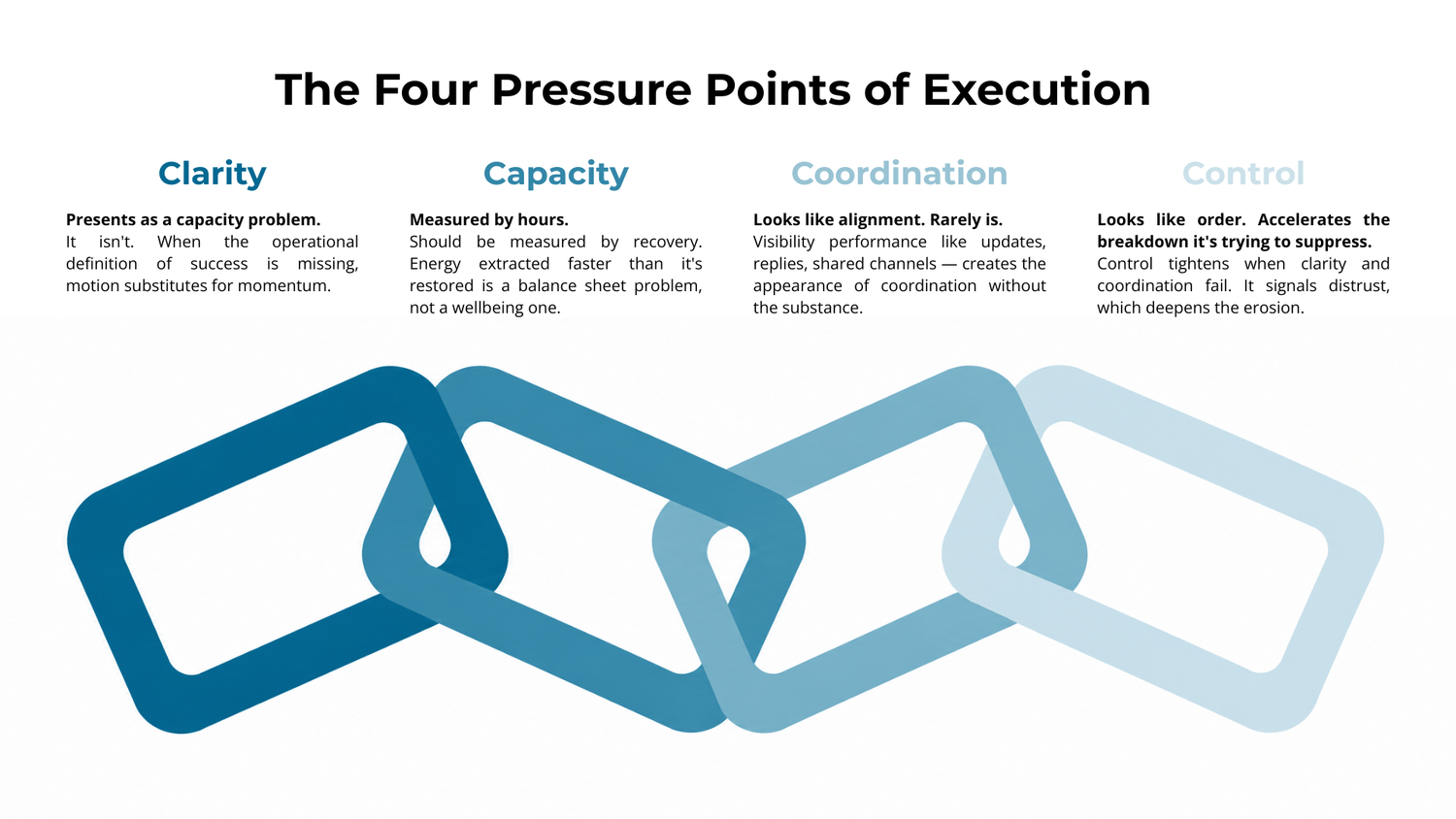
The Four Pressure Points
In brief: Across organisations of every size, work design breaks in the same four places: Clarity, Capacity, Coordination, and Control. Each has a recognisable broken state, a working state, and a diagnostic question. None of them respond to effort. They respond to design.
A lot of organisations have perfectly reasonable strategies. What breaks them is the gap between deciding and doing — the daily friction that most leadership frameworks do not touch and most productivity advice does not fix either.
Over years of working with founders, SMEs, and teams, the same four breakdowns appear — in the same sequence, with the same consequences. I call them the Four Pressure Points: Clarity, Capacity, Coordination, and Control.
These are not personality problems. They are not leadership failures. They are structural. And because they're structural, they respond to design — not effort, not motivation, and not another productivity tool.
The Clarity Pressure Point
What broken looks like
When clarity breaks down, it shows up as a capacity problem — not enough time, not enough people, not enough resources. So leaders respond with capacity solutions. More tools. More pivots. More effort. And none of it works, because the actual problem was never capacity. It was that no one could agree on what good looked like.
A dip in figures triggers an overhaul of the offer. A slow month triggers a website redo. A team misunderstanding triggers a new tool rollout. These are not irrational responses — they are entirely predictable responses to structural ambiguity. When no one is sure what success looks like at the operational level, everything feels urgent.
The deeper issue is the absence of a clear, actionable definition of success. Not the vision — most organisations have that. The practical signal: what does good look like this week, in this role, on this decision? Without it, people cannot move without escalating, second-guessing, or waiting for someone else to decide.
What working looks like
A team member hits an unexpected problem on Friday afternoon. They do not escalate, they do not stall. They make the call because they know exactly what matters most this week and what they are authorised to decide. That is what clarity at the organisational level actually looks like.
Diagnostic questions
If I asked five people in your organisation what the top three priorities are this month, would I get the same answer? When a decision stalls, is it because no one has the information or because no one is sure they have the authority?
The Capacity Pressure Point
What broken looks like
Most organisations measure capacity by input: hours logged, tasks completed, visible busyness. This is the wrong unit of measurement, and it creates the conditions for a slow, invisible collapse.
What happens in practice: energy is extracted faster than it is restored. There is no protected time between projects. No structural pause after something closes before the next thing begins. The cost does not show up immediately. It shows up in the quality of every subsequent project, in the decisions made under cognitive load, in the work that looks finished but is not.
What is often entirely missing is protected time for integrative thinking: connecting dots, reviewing what is actually working, adjusting course before a project overruns. Without it, teams are permanently reactive.
Firefighting is not a personality type. It is often the predictable result of a system with no room left for reflection, recovery, or good judgment.
And the impact is not just operational. It is cognitive. When priorities remain unresolved, ownership remains unclear, or decisions are repeatedly delayed, the brain continues to spend energy trying to keep those unfinished threads open — even when no one is actively working on them. The longer the uncertainty stays unresolved, the less attention remains for meaningful work. Organisations often treat clarity as a communication issue. It is also a capacity issue.
The same misunderstanding appears whenever organisations reach for scheduling solutions: working from home, flexible hours, phased returns, compressed weeks. These can all be valuable. But they do not create capacity.
Moving meetings, extending deadlines, or asking people to "be more resilient" may change when work happens, but they do not reduce the total cognitive and emotional load.
Scheduling can redistribute capacity. It cannot create it.
What working looks like
A manager has back-to-back delivery weeks in Q3. At the end of it, there is a week with lighter scheduling — not because nothing needs doing, but because the organisation knows that the quality of Q4 depends on what happens in that gap. She uses it to think, to catch up with her team, to notice what's been accumulating. She arrives at Q4 sharp.
Diagnostic questions
When did your team last finish something and actually stop before starting the next thing? Where in your organisation are you solving capacity problems with scheduling solutions rather than redesigning the work itself? Is your current workload something people could sustain for another twelve months without something breaking?
The Coordination Pressure Point
What broken looks like
Much of what passes for coordination is not coordination at all. It is visibility performance: update meetings, reply-all emails, and shared channels full of activity that create the appearance of alignment without the substance. This is expensive and almost never counted. The real cost is not the meeting. It is the four decisions that did not get made because everyone was in it.
The place where work most reliably breaks down is the moment it moves from one person to another. Not because anyone is careless, but because the question of who owns the next step was never made explicit. One person assumes the other is picking it up. The other assumes they are waiting for a signal. The work sits in the gap between them, invisible to both, until something goes visibly wrong.
As organisations grow, coordination complexity increases nonlinearly. A team of five creates roughly ten possible coordination relationships. A team of twenty creates nearly two hundred.
Without intentional work design, growth does not simply create more capacity. It also creates more interruption, more dependency, more clarification, and more “work about work.”
Over time, this fragmentation changes how people work cognitively.
When employees constantly switch context, track unresolved threads, and respond to competing priorities, attention becomes increasingly reactive rather than intentional. People struggle to filter what matters from what is merely urgent. Focus becomes shorter. Decision-making becomes noisier. Strategic thinking gets crowded out by continuous response.
The damage is not always immediately visible. But over time, fragmented work design reduces the very cognitive capacity organisations depend on for good judgment, prioritisation, and meaningful progress.
What working looks like
A project moves from the strategy team to the delivery team on a Thursday. Before anyone moves, one thing gets clarified: who owns the next decision, and by when? It takes four minutes. The delivery lead knows exactly what she is walking into and what she is authorised to change. The following week starts without a single clarifying email.
Diagnostic question
Pick any active project. Can you name the single person accountable for its outcome — not the team, one person? How much of your communication this week moved work forward versus kept people informed?
The Control Pressure Point
What broken looks like
The counterintuitive truth about broken control is: it does not look like chaos. It looks like excessive order: moreprocess, more hierarchy, more reporting, more rules.
Control tightens predictably when clarity breaks down, and coordination fails. It is a systemic response, not a leadership character flaw. The problem is, it accelerates the very dynamics it is trying to suppress: less trust, less ownership, less initiative, more performance anxiety, more fear. The organisation becomes increasingly rigid when it most needs to adapt.
When trust erodes, organisations replace judgment with metrics: more dashboards, tighter activity tracking, more reporting, and more approval layers.
But measuring more does not automatically create better work.
The closer people feel monitored, the more energy shifts toward managing perception rather than solving problems.
What breaks first is not performance. It is honesty. People start doing a quiet calculation — is it worth flagging this problem, or is it safer to manage it quietly and hope it resolves? When speaking up repeatedly feels riskier than staying silent, problems stop travelling upward. Projects fail for weeks before anyone says anything. Good ideas do not get killed in meetings. They just never get mentioned.
What working looks like
A junior team member notices something is off on a project — not a crisis yet, but heading that way. He mentions it to his manager that afternoon. Not in a formal report. Not after agonising over whether it will reflect badly on him. Just: "I think we have a problem developing here." His manager thanks him, they spend twenty minutes mapping it, and it gets addressed before the client ever knows. That is what a functioning control environment actually looks like. Not fewer problems — earlier identified ones.
Diagnostic question
When was the last time someone brought you a problem before it became a crisis? If a junior team member spots something going wrong, do they have a safe and clear path to raise it?
How Systems Break Quietly
In brief: Overloaded systems do not announce themselves. People respond to overload by accelerating — The Busy Loop™ — which maintains visible performance while deepening the underlying instability. Systems then fail in a recognisable sequence, and leadership experiences as sudden a breakdown that was accumulating all along.
The four pressure points describe where work design breaks. What they do not yet explain is why broken systems keep looking functional — sometimes for years. This chapter is about that gap: the mechanism that keeps overloaded systems running, the silence that keeps them invisible, and the sequence they follow when they finally fail.
The Energy Debt Mechanism
Most people do not respond to overload by stepping back. They respond by tightening their grip. They work faster, stay available longer, and say yes more often.They reduce recovery and switch tasks constantly.
These behaviours create a temporary sense of control and productivity. The inbox clears. Messages get answered. Work appears to continue.
But beneath the surface, the system becomes increasingly unstable. This is what I refer to as The Busy Loop™: a self-reinforcing cycle where overload encourages behaviours that temporarily maintain performance while simultaneously deepening energy debt.
What makes this cycle difficult to interrupt is that acceleration feels productive in the short term. The underlying instability remains unresolved, but the felt experience is one of coping.
Over time, speed itself becomes normalised. Slower reflection starts to feel uncomfortable. Rest feels irresponsible. People begin measuring their value by responsiveness, output, and how much they can sustain.
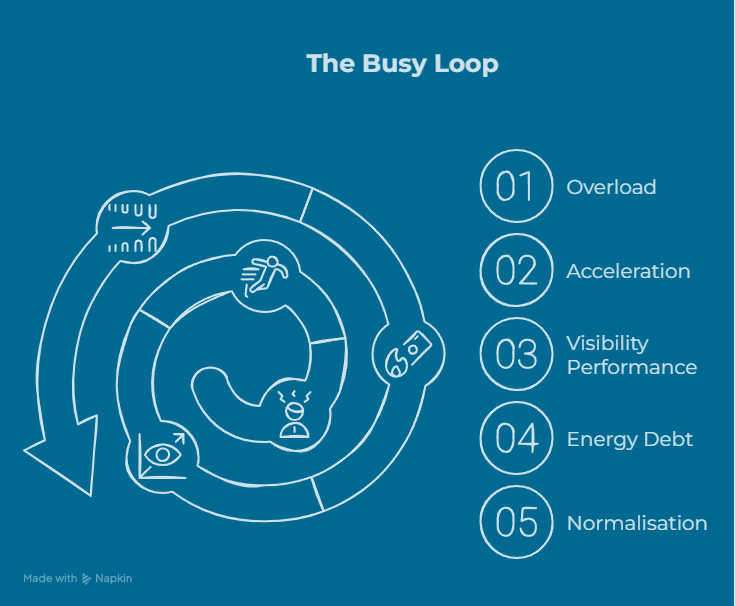
Yet the cost accumulates quietly: shallower thinking, more errors, reduced recovery, strained relationships, poorer decisions, and a growing feeling that life is being managed rather than lived.
This is why overloaded systems can remain invisible for so long. The behaviours they create often resemble commitment, ambition, and high performance — right up until the system begins breaking down.
How Overloaded Systems Stay Invisible
One of the most dangerous assumptions in modern work is that overload is temporary — that once people "catch up", the system will stabilise again.
But overloaded systems rarely stabilise on their own.
More often, they become more fragile while continuing to appear functional from the outside.
People compensate silently: working longer hours, recovering less, responding faster, and staying constantly available.
The output continues, which creates the illusion that the system is working.
But underneath the visible activity, the conditions that support sustainable performance slowly begin to break down.
Energy debt is what is happening to the system. The Busy Loop is why people keep participating in it even at their own expense.
The Work Instability Pattern
Overloaded systems rarely fail all at once. The failure tends to unfold in a recognisable sequence.
First, things appear to be working. Deadlines are met. People are responsive. The team pushes through. Therefore more meetings, more projects, more urgency, more tools get added, because the team is handling it.
But underneath the visible output, recovery disappears. Thinking narrows. Small problems remain unresolved longer. Communication becomes more reactive. Decisions happen later and under greater pressure.
The system becomes increasingly dependent on people compensating manually to keep work moving.
This creates fragility.
A healthy system can absorb disruption. An overloaded one cannot.
Eventually, something relatively small will trigger visible instability: a resignation, a delayed decision, a sick team member, a client escalation, a project slipping by two weeks.
Leadership experiences the breakdown as sudden.
But the instability has been accumulating long before the visible failure.
The absence of visible breakdown does not mean the system is healthy. It may simply mean people are compensating silently.
The Conditions We Optimised Away
In brief: Organisations pursued speed, visibility, and full utilisation — and achieved them. In the process they removed slack, recovery, structure, and thinking time: the conditions that made performance sustainable. What looked like inefficiency on a spreadsheet was the system working.
Productivity does not fail because people are undisciplined. It fails because the systems designed to increase performance quietly removed the conditions that make performance possible. Then blamed the people when performance declined.
This was not negligence. Organisations pursued legitimate goals — speed, scale, efficiency, visibility, coordination — and achieved them.
But in the process, many optimised away the very conditions that knowledge work depends on:
Uninterrupted focus
Recovery
Reflection
Clear ownership
Psychological safety
Thinking time
Slack
Human variability
The effects did not appear immediately. They appeared later: in rework, burnout, poor decisions, attrition, communication breakdowns, and work that looked finished but was not.
Clarity
What organisations told themselves they were gaining: Alignment, transparency, speed of decision-making, and operational consistency.
What they actually lost: The ability to distinguish what matters from what is simply visible.
More communication is not clarity. More tools are not clarity. More visibility is not clarity.
Clarity is knowing what matters, why it matters, and what you are responsible for making happen. Everything else is noise with good intentions.
Organisations optimised for alignment through increased communication, and lost the clarity that alignment requires. More channels, more meetings, more updates — each one added more information to the system without ensuring that the information was understood, prioritised, or acted on.
Decisions got faster and worse. Not because the people making them were less capable, rather because the pressure to decide quickly consistently outran the time needed to decide well. A decision made without sufficient context does not save time. It creates a second meeting, a reversal, a rework cycle, and a follow-up conversation that should have happened before anyone decided anything. The speed was real. So was the cost.
The debt that accumulated: organisations that could generate enormous amounts of activity while remaining genuinely unclear about what they were trying to accomplish and who was responsible for making it happen.
Capacity
What organisations told themselves they were gaining: Speed, utilisation, scale, coordination, and measurable performance.
What they actually lost: The cognitive space, autonomy, and quality of thinking that make speed worth having.
Organisations optimised for full utilisation and lost buffer capacity. A person running at one hundred percent has no room to absorb the unexpected. Full utilisation looks like efficiency on a spreadsheet, but it is fragile in practice.
Organisations optimised for visibility and measurable output, and lost the quality of thinking behind the work. Emails sent, meetings attended, tasks completed: these were countable. Deep thinking, problem framing, and strategic reflection were not. So organisations measured what they could see and gradually stopped protecting what they could not.
Organisations optimised for coordination across teams and lost autonomy. The more tightly people are synchronised, the more dependent they become on each other to move. Coordination at scale becomes a bottleneck dressed as collaboration.
The debt that accumulated: coordination dependency, decision delays, chronic under-capacity, and a workforce that learned to perform activity rather than produce outcomes.
System Load
What organisations told themselves they were gaining: Scalability, flexibility, self-sufficiency, and operational efficiency.
What they actually lost: The capacity to think and act without navigating the system itself.
Every tool, meeting, and process in an organisation either reduces the load on the people working inside it or adds to it. There is no neutral position.
In many cases, systems have become so complex that navigating the work has become a second job.
Remembering undocumented decisions. Tracking information across tools. Managing unclear ownership. Rebuilding context after interruptions. Translating between teams. Following up repeatedly to keep work moving.
None of this usually appears in job descriptions. Yet in many organisations, it becomes part of the job.
The complexity did not disappear. It shifted.
When the burden of navigating the system falls on the individual, it shows that the organisation has not solved its complexity problem.
It has handed it to the person least positioned to fix it.
The debt that accumulated: a workforce spending a growing proportion of its time managing the systems meant to help it work, rather than doing the work itself.
Recovery
What organisations told themselves they were gaining: Cost efficiency, output maximisation, and the elimination of unproductive time.
What they actually lost: The mechanism that makes sustained performance possible.
Recovery time, transition time, thinking time — all of it looks like a cost on a spreadsheet. So it was removed. The logic was straightforward: time not producing measurable output is time not producing value.
This logic contains a structural error. Recovery is not the absence of productivity. It is the condition that makes productivity sustainable. Rest, reflection, and white space are not rewards granted after output is achieved. They are the mechanism through which output quality is maintained over time.
The deeper problem is what gets counted as recovery. Organisations that define it narrowly — as sleep, exercise, and annual leave — miss the wider ecology of time on which human performance actually depends. Not time optimised for restoration. Time that exists without a purpose. The capacity to be unproductive without guilt is not a luxury. It is the condition under which genuine recovery occurs.
The WHO defines burnout in ICD-11 as an occupational phenomenon resulting from chronic workplace stress that has not been successfully managed, characterised by three dimensions: exhaustion, mental distance, and reduced efficacy. The word chronic is doing significant work in that definition. Burnout is not the result of a hard week. It is the result of a system that provides no structured recovery across time.
The WHO and ILO joint research goes further: working 55 or more hours per week is associated with measurable increases in mortality from ischaemic heart disease and stroke. Designing work that routinely demands this of people is not a neutral management choice. It is a risk management failure.
The debt that accumulated: a workforce whose capacity declined gradually and invisibly — through accumulated fatigue, degraded judgement, and disengagement — until the cost became impossible to attribute to any single decision.
Structure
What organisations told themselves they were gaining: Control, consistency, flexibility, and responsiveness.
What they actually lost: The deliberate conditions under which good work actually happens.
Structure is often misread as constraint. The instinct to remove structure in the name of agility, autonomy, or speed is understandable. But unstructured environments do not give people more freedom. They give people more questions to answer before they can begin. When everything becomes flexible, people end up carrying the cognitive load that the structure was supposed to hold.
Organisations optimised for flexibility and lost protected focus. When the working day has no defined structure — no periods reserved for deep work, no norms around meeting-free time, no shared agreements about communication — every hour becomes negotiable. The result is not flexibility. It is the permanent availability of everyone for everything, which is the condition most hostile to sustained thinking.
The debt that accumulated: organisations where missing structure was mistaken for resilience, and where the burden of flexibility and coordination was increasingly carried by individuals rather than the system itself.
What Was Lost Was Not Waste
What Got Removed
The conditions described above — cognitive buffer, role clarity, attention protection, recovery time, structural support — did not look like assets on the ledgers used to make decisions about them. They looked like inefficiency. They were removed with good intentions and measurable short-term gains.
But they were not inefficient. They were the system working.
What organisations optimised away were the structural requirements for sustained human performance. Their absence does not register as a single crisis. It registers as a slow, compound decline in decision quality, in capacity, in the ability of capable people to do the work they were hired to do.
When Life Itself Becomes a System
We not only optimised work. We optimised recovery itself. Sleep is now tracked and scored. Hobbies are monetised or abandoned. Friendships are maintained through networking logic. Rest is justified — if at all — by its measurable effect on next-day performance. What was once simply living has been reframed as inputs to be managed for return.
The problem is not only too much work. It is the inability to exist, at any hour, without optimisation. And that matters practically: unstructured time is not a reward for sufficient output. It is the condition under which people consolidate, create, and recover enough to return to work with perspective, energy, and clearer thinking.
Walter Kerr, writing in the mid-twentieth century, observed that busyness had become not just an economic necessity but a moral posture — and that a life organised entirely around productivity gradually leaves less room for rest, spontaneity, and simply being human. His critique was cultural, not economic. It maps precisely onto what has happened in organisations since.
What Mauritius Shows Us
Mauritius offers a unique window into what happens when modern work culture accelerates in a small, relational economy. Mauritius is not an exotic counterexample, but a compressed version of a transition most economies have already made or are currently making: the shift from work cultures built around relationship, presence, and slower rhythms toward ones increasingly shaped by digital speed, visible productivity, and optimisation logic.
The conditions that once characterised working life here — longer lunch breaks that doubled as community time, professional relationships built through genuine social presence, a cultural norm that allowed for unhurried conversation without it signalling disengagement — are not disappearing because they were inefficient.
Many of them were doing real work: sustaining the trust networks that reduce coordination costs, the relational fabric that supports psychological safety, the recovery rhythms that allow people to return to work with something left to give. All of this is disappearing because they do not look productive by the metrics now being imported alongside the tools, platforms, and management frameworks of the global knowledge economy.
Mauritius ranked 49th in the World Happiness Report in 2020 and 70th by 2024. The report does not directly measure work design. What it measures — social support, freedom, trust, and the quality of daily life experienced — are precisely the conditions that disappear when optimisation logic replaces relational ones.
The question that modernisation rarely stops to ask is not whether to change, but what to carry forward. The organisations and economies that perform best over the long term will likely be those that ask: “what are we losing in this process that we will later struggle to rebuild?” before the transition is complete.
The Labour That Does Not Count
In brief: When work systems become unstable, someone absorbs the instability — usually the people already praised for being adaptable, and most often women. This stability labour holds organisations together, costs real energy, and appears in no metric. A system that depends on it is running on a subsidy it has never acknowledged.
When work systems become unstable, someone absorbs that instability. Disruptions do not disappear. They get quietly redistributed to whoever is considered most available, most flexible, most able to fill the gap without any formal acknowledgement.
That redistribution is not random. It follows a pattern.
The people most likely to absorb it are the ones already praised for doing so. The ones described as adaptable, emotionally intelligent, collaborative, calming, and supportive.
In most organisations, those words are disproportionately used to describe women. The praise is genuine. The qualities are real. But at some point, qualities that an organisation keeps leaning on — without resourcing, recognising, or recovering the cost of — stops being a strength and becomes a hidden burden.
This is what might be called invisible stability labour. The rescheduling that happens without being asked. The emotional regulation that keeps a difficult meeting from derailing. The context-switching that covers for a system that never clarified who owns what. The quiet adjustment to changed circumstances that allows everyone else to keep moving. None of it appears in a productivity metric. None of it gets budgeted for. Still, all of it requires real energy — energy that accumulated as debt in the people doing it, while the organisation continued to assume it was free.
There is a particular irony in how this labour gets framed. Women are routinely praised for their capacity to carry it. Adaptability becomes a personal attribute rather than a systemic demand. Emotional intelligence becomes a natural gift rather than skilled, effortful work. The ability to remain calm when the system is failing is romanticised as a personality trait rather than recognised as labour with a cost.
And the system never asks whether it should change.
That question matters more than it might appear.
The dominant response to women navigating difficult work environments has been to offer them tools, training, and strategies to adapt more effectively — resilience programmes, communication coaching, and leadership development designed to help them fit more successfully into existing structures. The assumption underneath all of it is that the system is basically sound and the individual needs adjusting.
Recent discussions in Mauritius around extended maternity and paternity leave following the budget announcement illustrate this perfectly. Much of the debate I witnessed on LinkedIn in particular has focused on how long leave should be, who should pay for it, or whether working from home offers a practical compromise. These are important questions. But they all sit downstream of a bigger one: what assumptions are our workplaces built on in the first place?
If work is designed around the expectation of uninterrupted availability, then every period of care — whether for a newborn, an aging parent, an illness, or another life event — becomes a problem for someone to absorb. Changing the leave policy alone does not change the design of work.
The future of work is not only about helping women fit into existing systems. It is about redesigning systems around the reality that every person moves through periods of changing capacity. Care responsibilities, health, life transitions, neurodivergence, and aging are not exceptions to work. They are part of being human.
The organisations that thrive will not be those that expect individuals to quietly absorb these realities. They will be those that build work capable of adapting to them.
Because a system that structurally depends on unpaid, unrecognised labour to hold itself together is not a high-performing system. It is a system running on a subsidy it has never acknowledged — and has never had to, because the people providing it were too professional to stop or voice out.
AI and Acceleration: Efficiency Without Redesign
In brief: AI amplifies whatever work design it lands in. In overloaded systems, efficiency gains are absorbed by rising expectations before anyone has decided what to do with them. People are getting more done and falling further behind — both at once.
Most organisations adopting AI have a productivity goal. That is reasonable.
What is less examined is the assumption underneath it: that the current shape of work is basically sound, and that doing it faster will produce better outcomes. It will not necessarily do so. Speed applied to a broken system does not fix the system. It accelerates the debt.
Get through the inbox faster. Produce reports faster. Summarise meetings faster. Generate content faster. And AI does deliver on that. Tasks that once took hours now take minutes. The efficiency gains are real.
But efficiency is not a strategy. And speed without intention is not progress.
The more useful question is not how much faster AI makes the work. It is what happens when you accelerate a system that was already overloaded.
In 1955, Cyril Northcote Parkinson observed that work expands to fill the time available for its completion. He was writing about bureaucracy. The mechanism turns out to be universal.
When drafting a report takes thirty minutes instead of three hours, the organisation does not use the freed time for rest, reflection, or strategic thinking. It requests four more reports. It raises the expectation of output. It normalises a pace that was previously impossible.
Large-scale research confirms this directly: following AI adoption, time spent on messaging more than doubled, and business tool use rose by nearly 94%. Work became faster, more fragmented, and more cognitively demanding, not less. Deep work time dropped as coordination and communication increased. AI sped up task completion. The system filled the gained time with more tasks, more complexity, more cognitive load.
The dynamic is already visible in software development. As AI coding tools become standard, some organisations are optimising for the lowest token count — the cheapest, fastest code generation possible. The metric has shifted from the quality of the engineer's thinking to the cost of the output. What gets quietly devalued in that shift is precisely what no AI can supply: the judgment to know what should be built, the experience to anticipate what will break, and the understanding of context that makes the difference between code that works and a system that holds.
This is not a coding problem. It is a preview. When speed and cost become the primary measures, the conditions that produce quality work get optimised away, and the cost shows up later, elsewhere, on a larger scale.
More Done. More Behind.
The most common thing people say when they talk about AI at work is this: I am getting more done, but I feel more behind than ever. That is not a paradox. It is a predictable outcome of a specific dynamic.
What AI produces in a day was once a week's work. Once those outputs exist, they become the reference point. Stakeholders recalibrate. Clients expect faster turnaround. Managers see what is possible and immediately reassign the freed capacity. There is no organisational mechanism that says: we have become more efficient, so let us do the same amount with less pressure. The baseline just rises.
It only moves in one direction. The pressure — competitive, commercial, cultural — is always towards more. More output from the same people, or the same output from fewer. Efficiency gains get absorbed by rising expectations before anyone has agreed that's what should happen with them. The time saved does not stay saved.
The result is workload creep: obligations accumulating at the pace AI enables, without any corresponding reduction in what is demanded of the people inside the system. They are moving faster. They are further behind. Both things are true at the same time, and neither shows up on a dashboard.
What AI Cannot Accelerate
Not everything that matters can go faster. Thinking cannot always happen fast. Good judgment and the wisdom that comes from having been wrong, having dealt with a difficult problem, having changed your mind slowly — all this requires time that has nothing to do with typing speed.
The ability to synthesise information is not the same as the ability to generate it. Shallow synthesis replaces deep understanding when speed becomes the primary measure. Instant answers weaken the intellectual practice of working something out. Cognition requires friction sometimes — the resistance of not knowing yet, the discomfort of holding competing ideas before resolving them. That friction is not inefficiency. It is part of how humans think effectively.
There is also what might be called the consequence gap.
AI increases the volume of information, the speed of output, and the confidence with which conclusions are presented. It does not increase wisdom. It does not carry the consequences of the decisions it helps produce. The humans in the system still do. And humans processing decisions at AI speed, without the recovery time to integrate what they are learning, are not thinking faster. They are thinking less.
When the problem is unclear, AI produces nonsense faster. An unclear brief returns a polished, confident-sounding document that answers the wrong question well. This is not a failure of the tool. It is a failure of upstream clarity — the kind of thinking that happens before anyone opens a prompt. AI cannot create clarity for a system that has not done the thinking first.
There is a dimension to this that connects directly to the attention recession. Attention is not only about focus. It is about the capacity to be present with something long enough to understand it, not just process it. To notice what is not being said. To feel the resonance of an idea before deciding whether it is right. To sit with ambiguity without immediately resolving it into an output. These are human capacities. They require uninterrupted cognitive space. And they become harder and harder to access in environments built around speed and constant output.
The same applies to emotional processing. Organisations facing change, uncertainty, or difficulty need people who can hold complexity, read the room, and respond to what is actually happening rather than what the data says is happening. That capacity cannot be accelerated. It develops through experience, reflection, and the kind of unhurried human interaction that busy, fragmented work environments increasingly make impossible.
Amplifier, Not Corrector
AI is a powerful amplifier. That is precisely why work design matters more in an AI-enabled world, not less.
A system with clear priorities, protected capacity, and well-defined decision rights — AI makes it significantly more effective.
A system full of fragmented attention, overlapping responsibilities, and unresolved decision debt — AI makes it significantly more chaotic. The confusion arrives faster. The noise is louder. The overwhelm increases before anyone has identified its source.
You cannot reimagine the future by automating the past.
The question is not how much AI can do. It is whether the system it is operating inside is designed well enough to use what AI returns wisely, and human enough to know the difference between what can be accelerated and what must not be.
What Leaders Can Do Now
The analysis in this paper points in one direction. The problem is not simply workload. It is the design of the conditions under which people are expected to think, decide, collaborate, and recover.
There are three places leaders can start.
1. Track where the freed up time actually goes.
When AI reduces the time a task takes, follow where that time is redirected. If it is immediately consumed by additional output demands, nothing improved. The system accelerated without relief.
The reallocation needs to be made explicit and deliberate. Otherwise, the efficiency gain belongs to the baseline, not to the people who produced it.
2. Set quality standards before deploying speed.
AI produces outputs quickly. That is not the same as producing them well. Establish clear standards for what good looks like — especially for decision inputs — before speed becomes the default measure of success.
A response sounding confident does not mean the thinking behind it was sound.
The cognitive conditions required for execution and the conditions required for innovation are not simply different in degree. They are neurologically distinct. A brain operating under sustained task pressure has less access to the networks associated with creative thinking, perspective-taking, and strategic imagination.
Constant delivery pressure does not create better execution and innovation. Eventually, it will wear both down.
3. Put human-only time on the calendar.
Strategic reasoning, relationship building, genuine rest, and creative thinking are not rewards for efficiency. They are inputs to it.
If they are not protected structurally, they will be consumed. Schedule them the way you schedule everything else that matters. Because in a system optimised for speed, anything unscheduled disappears.
The Attention Recession does not end because we have better tools. It ends when we design work that makes better use of human attention and treats what AI returns to us not as capacity to fill, but as capacity to protect.
Counterarguments
A framework like this will meet reasonable objections. This section names them honestly.
"Isn't this just making excuses?"
This is the most common pushback and the most important one to answer precisely.
Arguing that productivity failure is often structural is not an argument against accountability. It is not a claim that individuals bear no responsibility for how they work.
The real point is that organisations routinely individualise structural problems. When a capable person burns out, the dominant response is to ask what they could have done differently — better boundaries, stronger habits, more resilience.
That framing removes responsibility from the system and places it entirely on individuals who cannot fix it on their own. The real excuse is calling a structural problem a personal one. This framework is an argument for designing conditions where accountability is realistically sustainable, not an argument for removing it.
"High performance requires pressure"
It may. But only sometimes. The distinction that matters is between acute and chronic pressure, and they are not the same thing operating at different lengths.
Acute pressure — a deadline, a product launch, a genuine crisis — activates focus. The nervous system responds, priorities clarify, and energy concentrates. This is a functional biological response to a time-limited demand. It works precisely because it ends. Recovery follows. The system restores.
Chronic pressure works differently. When the demand never resolves — when every week carries the same urgency, when recovery is treated as optional, when the baseline keeps rising — the nervous system does not stay activated. It stays dysregulated. Judgement degrades. Decision quality drops. The appearance of performance continues long after the capacity for genuine performance has quietly eroded.
This is why "just handle the pressure better" is not a solution.
Acute pressure handled well is a skill. Chronic pressure handled well is not resilient. People can appear highly functional long after the underlying strain has become unsustainable.
"We don't have time to redesign work"
Organisations are already spending the time. Just badly. The hours consumed by rework, coordination friction, delayed decisions, meetings that do not move things forward, and burnout recovery are not free. They are being paid now, invisibly, at a higher cost than deliberate redesign would require.
Redesigning work does not add time. It redirects it from reactive firefighting to deliberate design.
"Individual mindset and skills still matter"
They do. This paper was not written to remove individual agency from the picture. The argument is more specific: even highly capable, motivated people struggle inside systems built around fragmentation, overload, and unclear priorities. Sustainable performance requires both capable individuals and well-designed environments. This is not either/or. Systems thinking and individual accountability are not in conflict — poorly designed systems reduce the return on individual capability.
"This won't work in our culture / industry / context"
The need for better work design is not limited to one geography or industry. In many smaller, relationship-driven environments — including the Mauritian context, in which this work is grounded — these pressures become more concentrated, not less. Coordination load, visibility expectations, and interpersonal dynamics carry greater weight. The principles apply; the implementation adapts.
What Changes — The Organisational Impact
In brief: Redesigning around the four pressure points produces measurable effects: decisions made once instead of remade, output sustained instead of borrowed, coordination time returned as usable capacity, and better decisions made closer to the work. The four reinforce each other. The result is not slower work — it is work that breaks less often.
The preceding sections have made the diagnostic case. Work is overloaded. Attention is fragmented. AI is accelerating a system already under strain. The strain is compounding beneath the appearance of performance.
This section asks the practical question: if you redesign work along the principles in this paper, what actually changes?
These are not cultural initiatives.
They are operational redesigns with measurable business effects.
1. Clarity — Fewer Decisions Remade
In most organisations, a significant proportion of decisions are not made once. They are made, revisited, escalated, relitigated, and eventually remade — often with the same information that was available the first time. This is not indecisiveness. It is the predictable output of a system without a clear decision architecture: unclear ownership, undefined escalation paths, and misaligned priorities.
The cost is invisible on any dashboard. But it is real. Every decision remade consumes the time of everyone who made it the first time, everyone who challenged it, and everyone who waited for resolution before they could move forward.
When organisations redesign for clarity — defining who decides what, at what threshold, with what information — the first thing that changes is the decision cycle. Decisions move faster because less time is spent clarifying ownership, context, and next steps afterwards.
What leaders see: faster resolution, reduced escalation volume, higher-quality outputs from teams who aren't waiting for direction that never arrives.
2. Capacity — Sustained Output Over Time
There is a version of high performance that is not sustainable: teams running at maximum throughput, burning through reserves, delivering strong results in the short term, and quietly degrading in the medium term. It ends in attrition, burnout, or the sudden loss of institutional knowledge when the people carrying the load finally leave.
The question is not how much a team can produce. It is how much they can produce without the cost showing up later.
When work is redesigned with capacity as a managed resource, when recovery time is protected, when cognitive load is deliberately disturbed, and when the rhythm of work includes genuine deceleration, output often becomes more consistent over time. Teams lose less momentum to burnout, rework, turnover, and recovery crashes.
What leaders see: lower attrition, higher quality of output over longer periods, reduced sick leave and disengagement, and teams that perform when it matters.
3. Coordination — Time Returned to the Organisation
Coordination is the hidden tax on organisational performance. Every meeting that could have been asynchronous. Every status check that exists because handoffs are unclear. Every tool notification that interrupts deep work. These are not isolated inefficiencies. They are the accumulated cost of a coordination architecture that was never designed; it grew.
When organisations actively reduce coordination surfaces — fewer tools, clearer handoffs, explicit communication norms, protected time for deep work — the return is immediate and measurable. Time comes back. Not as empty calendar space, but as usable capacity: hours redirected toward actual work rather than maintaining visibility around work.
This is not about eliminating collaboration. Coordination debt and genuine collaboration are not the same thing. Redesigning coordination means removing the friction that consumes time without producing insight.
What leaders see: meeting load reduced, response-time expectations recalibrated, and measurable increases in time spent on strategic and creative work.
4. Control — Better Decisions at Every Level
In overloaded systems, decision quality degrades. Not because people are incapable, but because the conditions for good decisions are absent. Cognitive load is high. Time pressure compresses the space for reflection. Unclear decision rights mean that decisions travel upward to people furthest from the actual work and furthest from the information needed to make better decisions.
Control, in this context, does not mean centralisation. It means the right people making the right decisions with the right information at the right time. That does not happen because leaders become more controlling. It happens because decisions are clearer and closer to the work.
When decision rights are redistributed thoughtfully — when frontline teams have the clarity and authority to resolve operational questions without escalation, and when senior leaders are freed from the volume of decisions that should never have reached them — decision quality improves at every level.
What leaders see: reduced escalation volume, higher decision confidence at the team level, senior leadership time reoriented toward the decisions only they can make.
The Compounding Effect
These four changes are not independent. They reinforce each other. Clarity reduces the decision load on capacity. Coordination redesign creates the time needed for capacity to recover. Better decisions, made closer to the work, reduce the coordination overhead required to manage their consequences.
The result is not slower work. It is work that breaks less often.
A Note on Measurement
Leaders will reasonably ask: how do we know if it's working?
The answer is to measure what the current system makes invisible.
The organisations that manage this well measure earlier signals instead:
Decision cycle time: how long from question to resolution?
Escalation rate: what proportion of decisions travel upward unnecessarily?
Meeting-to-output ratio: how much coordination is producing how much progress?
Recovery markers: absenteeism trends, engagement pulse, self-reported capacity.
These are not soft metrics. They are early-warning signals for the systemic risks that, left unmanaged, become the hard costs: attrition, burnout, quality collapse, and the slow exit of the people the organisation most needs to keep.
The Mechanism That Makes It Stick
None of these four changes is a one-time intervention.
Clarity gets harder to maintain as organisations grow and priorities shift. Capacity gets squeezed when demand rises. Coordination surfaces accumulate by default. Decision rights blur as structures evolve. The redesign of work is not a project with a completion date. It is a practice.
The organisations that sustain these gains build continuous listening into the system: regular, structured ways of collecting real data from the people doing the work. Not annual engagement surveys that produce a report nobody acts on. Shorter, more frequent signals: what is creating friction this month, where is capacity being exceeded, which decisions are stalling and why.
The common objections are that this is too complicated or that the ROI is unclear. The question is not whether there is a cost. The organisation is already carrying it. The hidden cost of not listening shows up in burnout, in rework, in attrition, in the quiet disengagement of capable people who stopped raising problems because nobody acted on them the last time they did.
Continuous listening does not add to the system’s cost. It helps organisations notice strain before it becomes a breakdown and before the consequences become expensive.
The Shift: From Discipline to Design
In brief: The productivity problem has been misdiagnosed as a discipline problem. The alternative is to redesign the conditions people work in — decision architecture, communication norms, recovery rhythms — rather than training people to survive them. That shift is the foundation of Peaceful Productivity®.
The Wrong Diagnosis
For decades, productivity problems have largely been treated as personal ones. When burnout rises, we offer resilience training. When teams fall behind, we ask individuals to communicate better, prioritise harder, or manage their energy more carefully.
Some of these interventions help. But most work at the margins because they focus on helping people survive systems that were never designed for sustainable human performance in the first place.
The problem is not that individual mindset and skills do not matter. They do. But when exhaustion, fragmentation, and overload become widespread patterns, the issue is no longer just individual discipline. It is work design.
The Design Shift
A different question emerges:
What would work look like if it were designed around how human beings actually sustain focus, judgement, creativity, recovery, and collaboration over time?
That question changes where solutions are sought.
Instead of placing the full burden on the individual, attention shifts toward the environment itself: decision architecture, communication norms, recovery rhythms, role clarity, coordination load, and attention protection.
This is the shift from productivity as personal optimisation to productivity as system design.
And it is the foundation underneath Peaceful Productivity®.
Peaceful Productivity®: A Philosophy, Not a Method
The Attention Recession cannot be solved by better personal habits. It is solved by a different design. Peaceful Productivity® emerged from that question. Not as another personal productivity system, but as a work design philosophy: what would work look like if human attention were treated as the resource it actually is?
Not another set of habits, routines, or focus techniques. Those things can help. But they are not the foundation.
The problem is not the person. The problem is the system the person is working in.
Attention is a managed resource. Organisations budget money carefully and attention not at all. Every meeting, channel, and notification spends it. A work design that does not account for where attention goes is running its scarcest resource without a ledger.
Recovery is part of the work, not the reward for surviving it. Capacity is restored, not willed. A system that consumes energy faster than it restores it is not performing — it is borrowing. The debt comes due in decision quality, in errors, in departures.
Capacity is created by changing the work, not moving it around. Rescheduling, redistributing, and reprioritising shift load between people and
weeks. Only removing friction — an unnecessary approval, a redundant meeting, an unclear handoff — actually creates capacity.
Work should be designed for the people who exist, not the worker the model assumes. Human capacity varies — across a day, a season, a life. Designs that assume constant, identical output do not eliminate that variation. They just push the cost of it onto the people least able to refuse it.
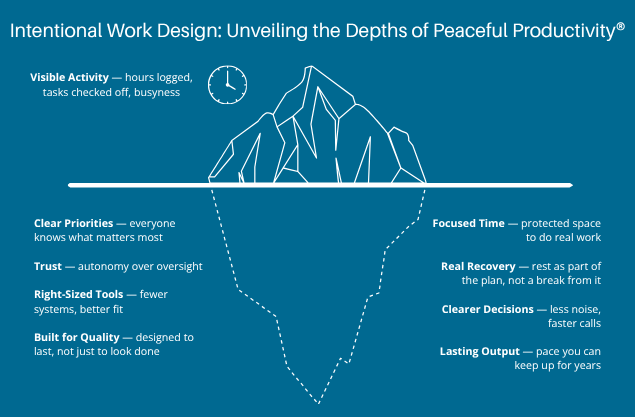
These are not productivity techniques. They are principles for designing work. The goal is not more output at any cost, but sustainable output without human depletion.
Peaceful does not mean slow or unambitious. It means reducing the unnecessary friction that makes work harder than it needs to be. Peaceful is not the opposite of productive. It is what makes sustained productivity possible.
In other words, the design of work matters more than the discipline of the people inside it.
The Leader's Role
The organisations that will perform best in the coming decade will not be the ones that found people who could withstand the most pressure. They will be the ones that stopped generating unnecessary pressure in the first place.
Some organisations have already begun redesigning work around the realities of human capacity. They have taken different approaches, but they share one characteristic: they changed the system rather than expecting individuals to absorb the pressure.
Microsoft tested a four-day workweek, reduced meetings, and pushed for more intentional communication. Shopify removed large volumes of recurring meetings to protect uninterrupted work time. Basecamp built its entire operating culture around asynchronous communication and calm work environments. Buffer adopted remote-first work with flexible schedules and regular well-being check-ins. Patagonia embedded family support into work design itself, rather than treating it as an optional benefit. KPMG and Deloitte have both moved toward structured wellbeing support, mental health initiatives, and sustainable performance programmes.
In Mauritius, Aspen introduced extended maternity and paternity leave before broader policy changes were announced nationally. Whether through parental leave, flexible working, or wellbeing initiatives, organisations like Aspen recognise an important reality: sustainable performance cannot be separated from the realities of life outside work.
None of these are perfect organisations. But each made a structural decision rather than a personal one. They changed something about the system, not just the messaging.
What made those changes stick was not a single initiative. It was a commitment to continuous listening — collecting real data from the people doing the work, regularly and honestly, and using it to make ongoing adjustments.
The impact of these changes is rarely dramatic at first, but structural improvements compound over time.
Gradually, organisations spend less energy managing friction and more energy doing meaningful work. That is a real competitive advantage.
That is what leaders can build. Not by working harder themselves. By designing better.
The Next Step — From Insight to Action
The Honest Starting Point
Before redesigning anything, you need to know what your current work design is already costing you. Not in general terms. In numbers, your organisation actually recognises: time lost, decisions delayed, capacity consumed by friction that should not exist.
Most leaders have a felt sense of this cost. They see it in the meeting load that never decreases. In the talented people who leave without fully explaining why. In the projects that take longer than they should, not because the work is hard, but because the conditions around the work are unclear.
What most leaders lack is a clear picture of the accumulation. What all of that friction, added up, is actually worth in lost productive capacity. That is the starting point. Not a strategy. Not a redesign. A diagnosis.
That diagnostic does not have to start with a consultant or a strategy offsite. It can start with a single question: “What is your current work design actually costing you, in numbers your leadership team can work with?”
Ten Questions Worth Sitting With
Every section of this paper ends in a question because the diagnosis does not belong to me. It belongs to whoever runs the system. Here they are in one place. They are deliberately uncomfortable. If one of them is easy to answer, move on.
Clarity
1. If I asked five people in your organisation what the top three priorities are this month, would I get the same answer?
2. When a decision stalls, is it because no one has the information or because no one is sure they have the authority?
Capacity
3. When did your team last finish something and actually stop before starting the next thing?
4. Where are you solving capacity problems with scheduling solutions rather than redesigning the work itself?
5. Is your current workload something people could sustain for another twelve months without something breaking?
Coordination
6. Pick any active project. Can you name the single person accountable for its outcome — not the team, one person?
7. How much of your communication this week moved work forward, versus kept people informed?
Control
8. When was the last time someone brought you a problem before it became a crisis?
9. If a junior team member spots something going wrong, do they have a safe and clear path to raise it?
System
10. What is your current work design already costing you — in numbers your leadership team can work with?
The ones you hesitate over are the ones doing their job.
The Design Decision
You did not build an overloaded organisation on purpose. No one does. Complexity accumulates incrementally. Coordination layers get added one meeting at a time. Decision rights blur gradually as organisations grow faster than their structures adapt. Attention gets fragmented slowly, notification by notification, tool by tool, until the default working day is a series of interrupted hours that never quite add up to the focused work that moves things forward.
Nobody designed it this way. That matters because it means you do not need a crisis to justify changing it.
These problems were built slowly. One meeting at a time. One workaround at a time. One unclear decision path at a time.
Which also means they can be redesigned deliberately, one structural decision at a time.
And it starts with knowing what you are actually dealing with.
A NOTE ON DISAGREEMENT
This paper is an argument, not a verdict. It is built on patterns I've observed over years of working with founders and teams, on the research cited throughout, and on a definition of productivity that some readers may not share.
If something here contradicts your experience — if your organisation runs at full utilisation and thrives, if the pressure points break in a different order for you, if you think the diagnosis is wrong — I would genuinely like to hear it.
That is not a courtesy. Disagreement from people leading real organisations is some of the most valuable feedback this work can receive.
Ready To Take Action?
Working with Virtufully
The Productivity Loss Calculator
The starting point. A ten-minute diagnostic that estimates what unclear roles, fragmented attention, and coordination overhead are currently costing your organisation — in numbers your leadership team can work with. It returns a starting point, not a verdict.
Lunch & Learn:
Designing Better Work
A two-hour interactive session introducing the ideas behind Designing Better Work. We explore how attention, capacity, coordination, and work design influence performance, and where small structural changes can have the greatest impact.
Team Productivity Reset - MQA Approved Training
For organisations ready to act. A structured, facilitated programme that addresses the root causes at the team level, where the work actually happens. Built around ten Work Design Diagnostics across Clarity, Flow, and Human System domains.
A note on how this paper was written
The argument, frameworks, and observations in this paper come from Anne's my work with founders, SMEs, and teams — the Four Pressure Points, Work Debt, and the Busy Loop are drawn from patterns she has watched repeat across organisations for years.
The author used AI (Anthropic's Claude) as an editorial partner in developing it: pressure-testing the structure, tightening drafts I had written, and challenging arguments that were not yet earning their place. Every claim, every position, and every sentence that ships in this paper was reviewed, rewritten, or deliberately kept by Anne Rajoo.
She works on how organisations adopt AI without losing judgment, depth, or honesty in the process and holds this paper to the same standard.
Quick links
Follow us
What is unclear work actually costing you?