
What Looks Like Commitment
Rethinking the "Good Employee" Norm
Opening Observation
Something I've been sitting with after recent work with a team: the people who were most visibly struggling with overload were not, for the most part, the people who complained about it.
They were the ones who stayed late without being asked. Who responded to messages on weekends. Who volunteered for the additional project even when they were already at capacity. Who never said no — not because they couldn't see the problem, but because saying no felt more dangerous than absorbing it.
From the outside, these people looked like high performers. Committed. Reliable. Always available. And in many organisations, they were treated as such — praised for their dedication, held up as examples.
What was harder to see was what it was costing them.
The Hidden Dynamic
The message arrives at 7pm.
It gets answered.
The request comes in on a Friday afternoon. It gets absorbed.
Leave gets approved. The laptop comes along anyway.
A colleague needs cover. Of course. No problem.
The child's school calls at 3pm. The parent steps out, handles it, and is back at the desk by 3:20. Nobody mentions it. It is simply managed.
Each of these moments passes without comment. Each one feels like a reasonable response to a reasonable situation. But they accumulate. And underneath the accumulation is a belief that has never been spoken aloud, never been written into any policy, and never been formally required — but is understood nonetheless:
This is what it looks like to be good at your job here.
The organisation did not create this belief deliberately. But it sustains it — through what it rewards, what it notices, and what it never questions. The person who leaves at 5pm with work unfinished is quietly marked. The person who stays until the work is done is quietly admired. And so the standard sets itself, without anyone ever deciding that it should.
For women, and particularly for women who are also managing a household, caring for children, or supporting ageing parents, this norm lands differently. Not because the expectation is formally different. But because the capacity available to meet it is. The second shift — the one that begins when the working day ends — does not distribute itself evenly.
And the organisation, in most cases, proceeds as if it does not exist.
Organisational Example
Consider a senior team member in a professional services firm. She is experienced, trusted, and consistently rated as one of the strongest performers in her function. She is also, by any honest accounting, running on empty.
She responds to client messages in the evenings because the daytime is consumed by internal coordination. She prepares for presentations over weekends because the week does not contain enough uninterrupted hours. She has not taken a full day of leave in eight months — not because none was approved, but because disconnecting fully has come to feel professionally unsafe.
When her manager raises her development trajectory in a performance conversation, the discussion turns to visibility, executive presence, strategic contribution. The right conversation, in many respects. But the prior conversation — the one about what is actually making the current pace unsustainable — does not happen.
Not because her manager doesn't care. Because the organisation has no shared language for it. Overextension has been normalised to the point where it no longer reads as a signal. It reads as dedication.
Leadership Insight
The "good employee" norm is one of the most durable fictions in organisational life. It persists not because anyone defends it explicitly, but because no one examines it.
When availability becomes the visible proxy for commitment, organisations lose the ability to distinguish between people who are performing well and people who are simply absorbing more than they should. The two can look identical from the outside — until one of them leaves, burns out, or quietly withdraws the discretionary effort that was never formally required but was always quietly expected.
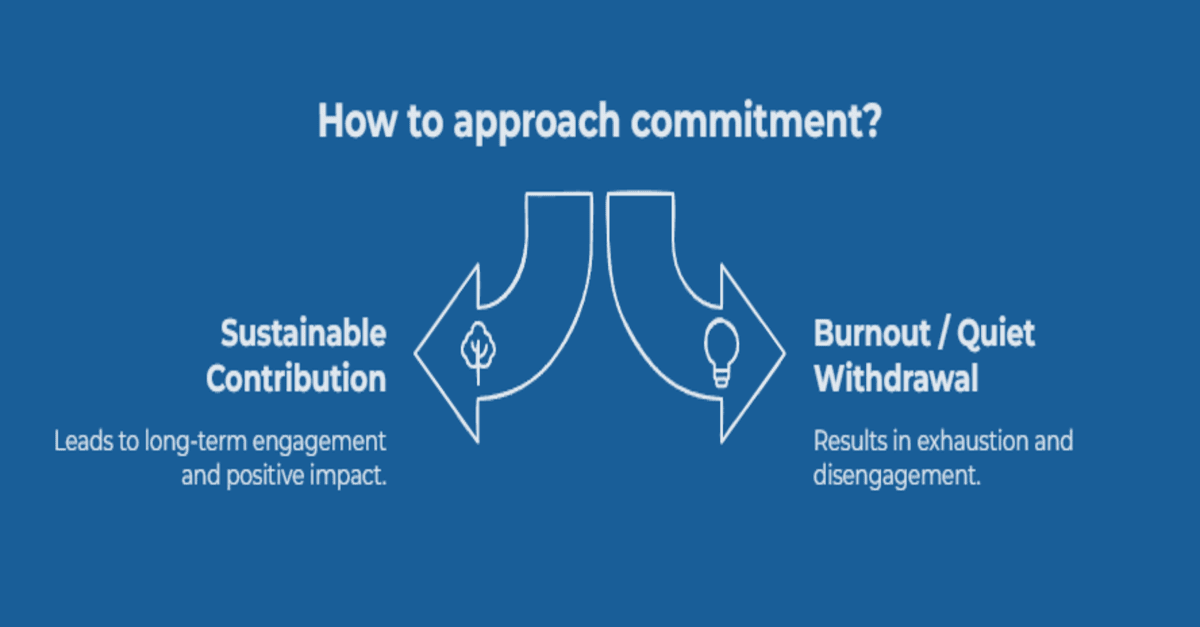
The gender dimension matters here, and it is worth naming directly. Organisations that do not account for the unequal distribution of care responsibilities outside work are not operating on a level surface — regardless of their formal policies. When the standard for dedication is defined by total availability, it systematically disadvantages the people carrying the heaviest load outside the office. Most of the time, those people are women.
Something a participant said to me recently in a corporate training session on this exact pattern has stayed with me. The biggest shift for them wasn't a new tool or a new system. It was learning to pause before reacting to urgency. That pause — barely a few seconds, easy to miss — was the difference between absorbing every request on instinct and actually choosing what deserved their attention. Small intervention. Structural effect.
Recent discussions here on LinkedIn following the announcement of the extended maternity and paternity leave in Mauritius have brought this dynamic into sharper focus. Much of the debate has centred on the cost to employers - especially SMEs - or the length of leave itself. Less attention has been paid to the assumptions underneath: who is expected to absorb the work of care, how that affects available capacity, and whether our workplaces are designed around the reality of people's lives or around an idealised worker with few competing responsibilities.
Redesigning this does not require a policy overhaul. It requires leaders who are willing to ask different questions. Not just is this person performing? but what is this person carrying, and is the environment we've built making that sustainable?
That shift in question changes what becomes visible and what leaders become responsible for.
Closing Reflection
Where in your organisation might overextension be passing as excellence — and what would it take to tell the difference?
These are conversations I'm increasingly having with leadership teams across Mauritius. If this is something you're navigating inside your own organisation, I'd genuinely enjoy hearing your perspective.
If this article was useful, the next one will be too.
Get one thoughtful edition each month on organisational clarity, team productivity, smarter systems, and future-ready ways of working.

Start With Clarity!
If your team feels busy but progress feels harder than it should, begin by understanding what’s really causing the friction.
What is unclear work costing you?
Use the calculator to estimate lost time, hidden friction, and productivity drag.
Free Guide: 3 Drivers of Productivity Loss
Understand the hidden causes of slow progress and reactive work.
Quick links
Follow us
What is unclear work actually costing you?